

Why every business acquisition needs an IT due diligence audit — before you sign
When a national group acquires an independent professional services practice, due diligence is usually thorough — until it reaches IT. The accounts are audited line by line, client books are checked, and the lease is reviewed. But the systems, security, and infrastructure the practice relies on are often taken on trust, or reduced to a few checklist questions that no one in the room is qualified to assess. That is why IT due diligence before buying a business is essential.
That gap is where risk hides. And once completion happens, it’s no longer the seller’s problem — it’s yours.
What financial due diligence misses
A set of accounts will tell you whether a practice is profitable. It won’t tell you whether the firewall is end-of-life, whether backups have ever actually been tested, whether former employees still have access to client data, or whether the practice is one phishing email away from a ransomware incident that halts client work for weeks.
For a business built on acquiring and integrating other businesses, that’s not a one-off risk. It’s a risk you’re taking on with every single deal — and it compounds across a growing group unless someone is checking for it every time.
Introducing the Business Buyout Audit
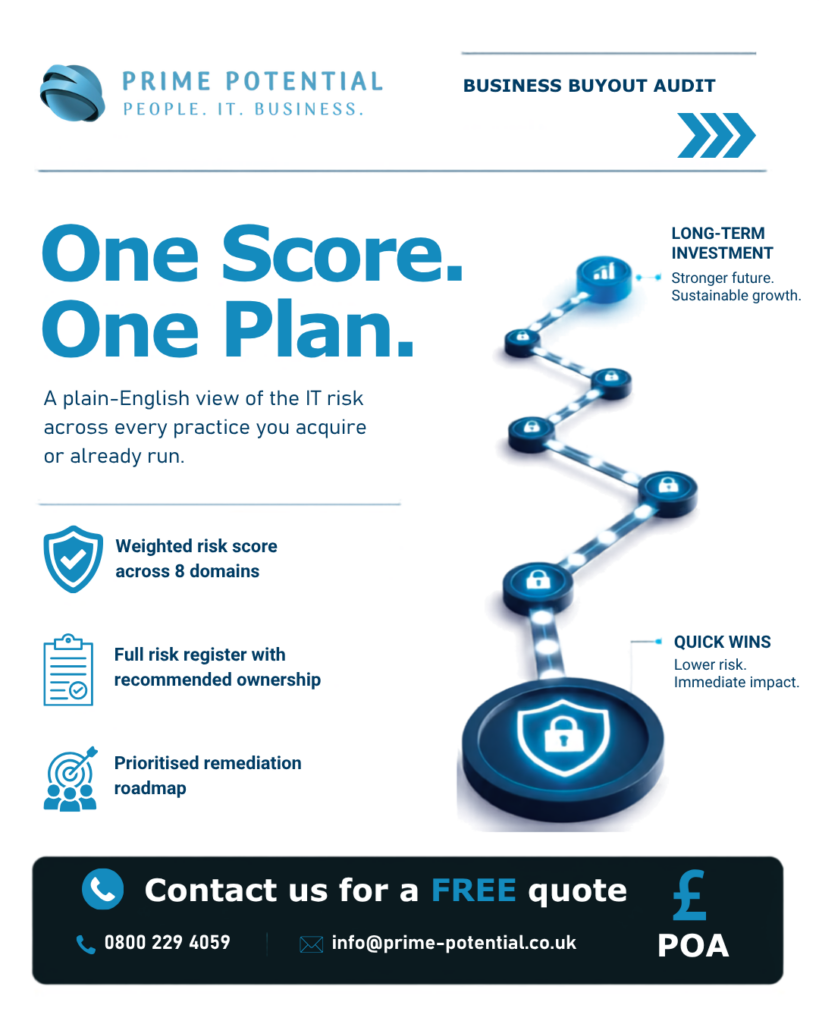
The Business Buyout Audit is Prime Potential’s IT, cybersecurity and compliance assessment built specifically for accountancy and professional services groups that grow through acquisition. One senior consultant works on site, scoring 64 controls across 8 domain areas against documented evidence — not assumptions or a self-completed questionnaire from the seller. The result is a single, plain-English report with a weighted risk score and a prioritised roadmap. Including any new equipment or infrastructure that is needed and marked with priority.
Who it’s for
This audit is built for national or multi-site groups acquiring, or already running, local independent practices — the kind of consultative due diligence a management buyout or bolt-on acquisition needs, but rarely gets when it comes to IT. It works equally well used once, ahead of a single deal, or applied consistently as a standard step in every acquisition a group makes.
Why timing matters: audit before you sign
The single biggest lever here is timing. Run this audit before completion, and any IT or security gaps become negotiating points — reflected in price, addressed in the sale agreement, or resolved before the deal closes. Run it after completion, and those same gaps are simply inherited: your budget, your risk register, your incident to manage if something goes wrong first.
That’s why pre-acquisition due diligence is the audit’s primary use case. It gives you an evidence-based view of exactly what you’re taking on — before it’s too late to do anything about it other than fix it.
Eight domains, one clear picture
Every audit scores the same 8 domains, so results are consistent and comparable across every practice a group acquires:
- Cyber Security & Threat Protection — firewalls, endpoint protection, patching, email security, incident response.
- Identity & Access Management — MFA, joiners/movers/leavers process, privileged access, least privilege.
- IT Infrastructure & Network — network design, server estate, segmentation, monitoring, resilience.
- Backup & Disaster Recovery — backup coverage, restore testing, ransomware protection, RTO/RPO.
- Licensing & Asset Management — software and hardware registers, contracts, cyber insurance.
- Cloud & SaaS Configuration — tenant security baseline, DLP, external sharing, admin roles.
- IT Governance & Compliance — policies, UK GDPR, sector regulation, risk register.
- Business Continuity Planning — BCP coverage, testing, single points of failure, crisis integration.
How it works
Step 01 · Scope: Agree the engagement
We agree whether this is pre-acquisition due diligence, post-acquisition integration, or a recurring health check — plus the sites, systems and users in scope.
Step 02 · Audit: On-site, evidenced
A consultant scores 64 controls across 8 domains — from firewalls to backup testing to business continuity — against evidence, not guesswork.
Step 03 · Report & Roadmap: One score. One plan.
You receive a weighted risk score, plain-English findings, and a roadmap from quick wins through to longer-term investment — plus a full bespoke quotation to remediate any actions raised.
What you get
- A weighted risk score across all 8 domains
- A plain-English summary any stakeholder can follow, technical or not
- A full remediation roadmap with top priorities actioned first
- A full risk register with recommended actions and named ownership
Three ways to do it & use it
- Pre-acquisition due diligence — before you sign on the dotted line
- Post-acquisition integration — bring the practice into your business with a clear plan
- Recurring checks and audits — track risk year to year across the group
The bottom line
Buying a business without auditing its IT is buying blind on one of the areas most likely to cost you after completion. The Business Buyout Audit gives you the evidence, the score, and the roadmap to know exactly what you’re taking on — and a clear plan to deal with it — whether that’s before you sign, right after integration, or as an ongoing check across every practice in the group.
It saves you time, puts the thinking in one place, and takes the stress out of an area most deal teams aren’t equipped to assess themselves.
Book your Audit Scoping Call — no obligation
0800 229 4059 | info@prime-potential.co.uk
Contact us for a free quote to get your audit scoped and priced to your requirements.


